


 189
/
3
Min Read
189
/
3
Min Read


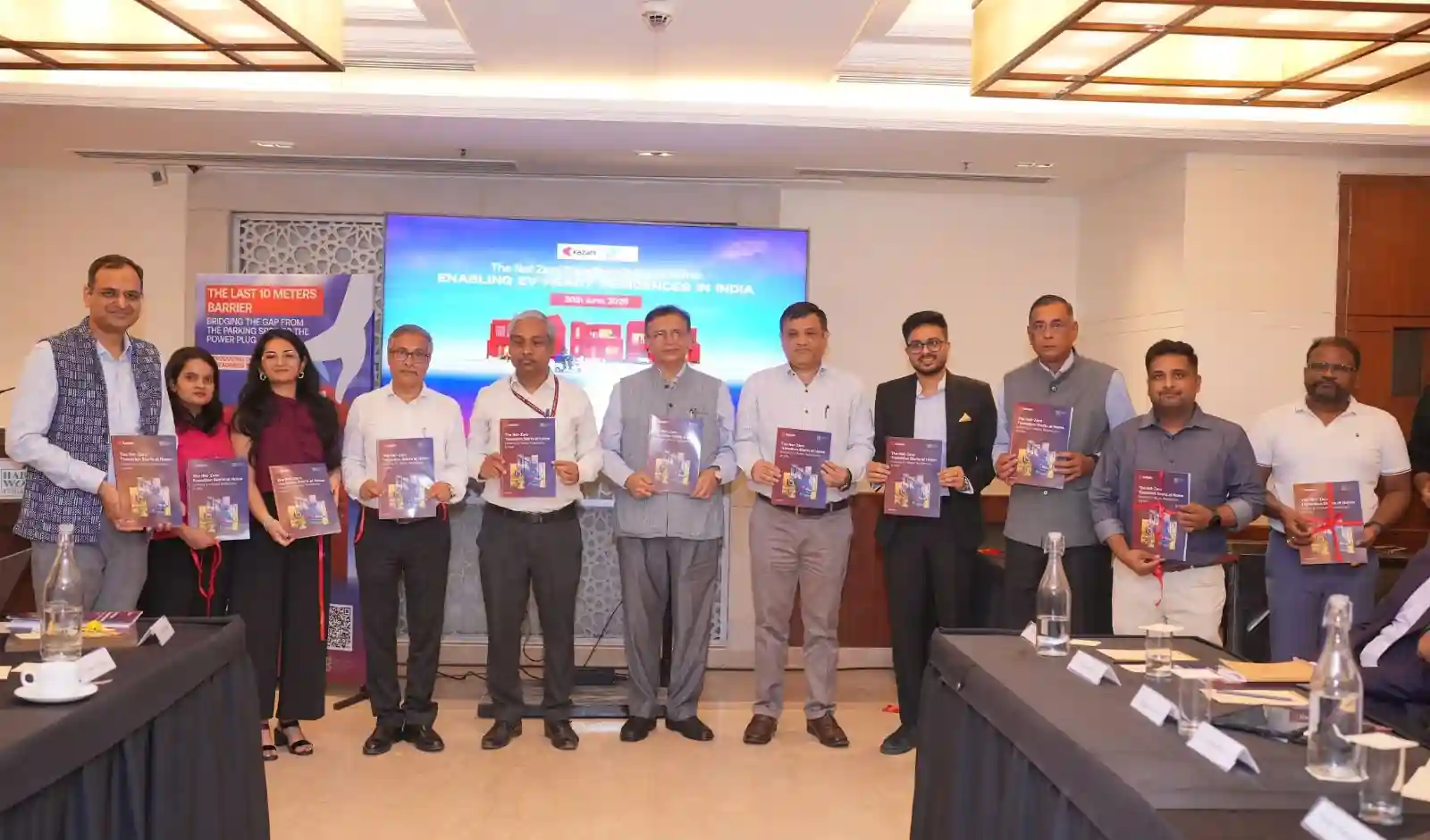
EV charging and energy management company Kazam, in partnership with the Alliance for an Energy Efficient Economy (AEEE), has released a report titled "The Net-Zero Transition Starts at Home: Enabling EV-Ready Residences in India." The report highlights that safe and well-planned residential charging infrastructure is one of the most critical yet overlooked enablers of India's electric vehicle (EV) transition.
The report was launched at the India Habitat Centre in New Delhi in the presence of senior officials from the power and energy sector, including Amal Sinha, Director, BSES; Sameer Pandita, Director, Bureau of Energy Efficiency (BEE); Irfan Ahmad, Chief Engineer, Central Electricity Authority (CEA); energy transition leader Saurabh Kumar; and Satyendra Nath Kalita, Director (Regulatory Affairs), All India Discoms Association.
The findings are based on Kazam's proprietary dataset of more than 80,000 residential EV charger installations, supported by field surveys and consumer interviews conducted across over 5,000 pin codes, including high EV adoption states such as Assam, Rajasthan, and Uttar Pradesh.
According to the report, India's EV market is largely driven by electric two-wheelers and three-wheelers, which accounted for nearly 90% of total EV sales in 2025. Since most of these vehicles are charged overnight at home, residential charging infrastructure has become increasingly important. However, nearly half of prospective EV buyers still lack access to formal home charging facilities.
The report identifies three major barriers to scaling residential EV charging. The first is the growing pressure on residential electricity networks due to overnight charging sessions lasting four to six hours. The second involves safety concerns such as overheating and melting of conventional household sockets, voltage fluctuations, and inadequate earthing. The third is the lack of charging infrastructure in apartment complexes, where 70-75% of urban households reside, resulting in challenges related to dedicated parking, installation approvals, and permissions from Resident Welfare Associations (RWAs) and landlords.
As part of the launch, Kazam and AEEE also convened a multi-stakeholder roundtable with representatives from government agencies, power utilities, the EV industry, and the real estate sector. The discussion focused on a proposed EV-Ready Residences Framework, which recommends standards covering adequate sanctioned electrical load, legal metering, dedicated charging circuits, proper earthing, safe wiring practices, and consumer awareness. The framework is expected to be developed further in consultation with the Bureau of Energy Efficiency (BEE) to help homebuyers, residents, and developers assess a property's readiness for EV charging.
Kazam also introduced an online EV-Readiness Quiz, enabling prospective EV buyers to evaluate whether their homes are prepared for EV charging and, where necessary, book a professional electrical assessment.
Akshay Shekhar, Co-founder and CEO of Kazam, said that creating safe and EV-ready homes is essential to sustaining consumer confidence in electric mobility. He added that EV charging infrastructure should be integrated into residential planning, building approvals, and occupancy certifications, while government initiatives such as PM E-DRIVE and state EV policies can support electrical upgrades for low-income and rental households.
The report also highlights that India's gig workforce is expected to reach 23.5 million by 2030, making access to home charging increasingly important. Workers dependent on public charging not only lose productive working hours but also pay three to four times more per unit of electricity compared to residential charging.
Sumedh Agarwal, Director – Smart and Resilient Power and Mobility at AEEE, said that while EV adoption in India is accelerating, residential infrastructure remains unprepared for large-scale electrification. He emphasized that safe, affordable, and accessible home charging infrastructure will play a decisive role in the next phase of India's EV transition.


