


 272
/
2
Min Read
272
/
2
Min Read


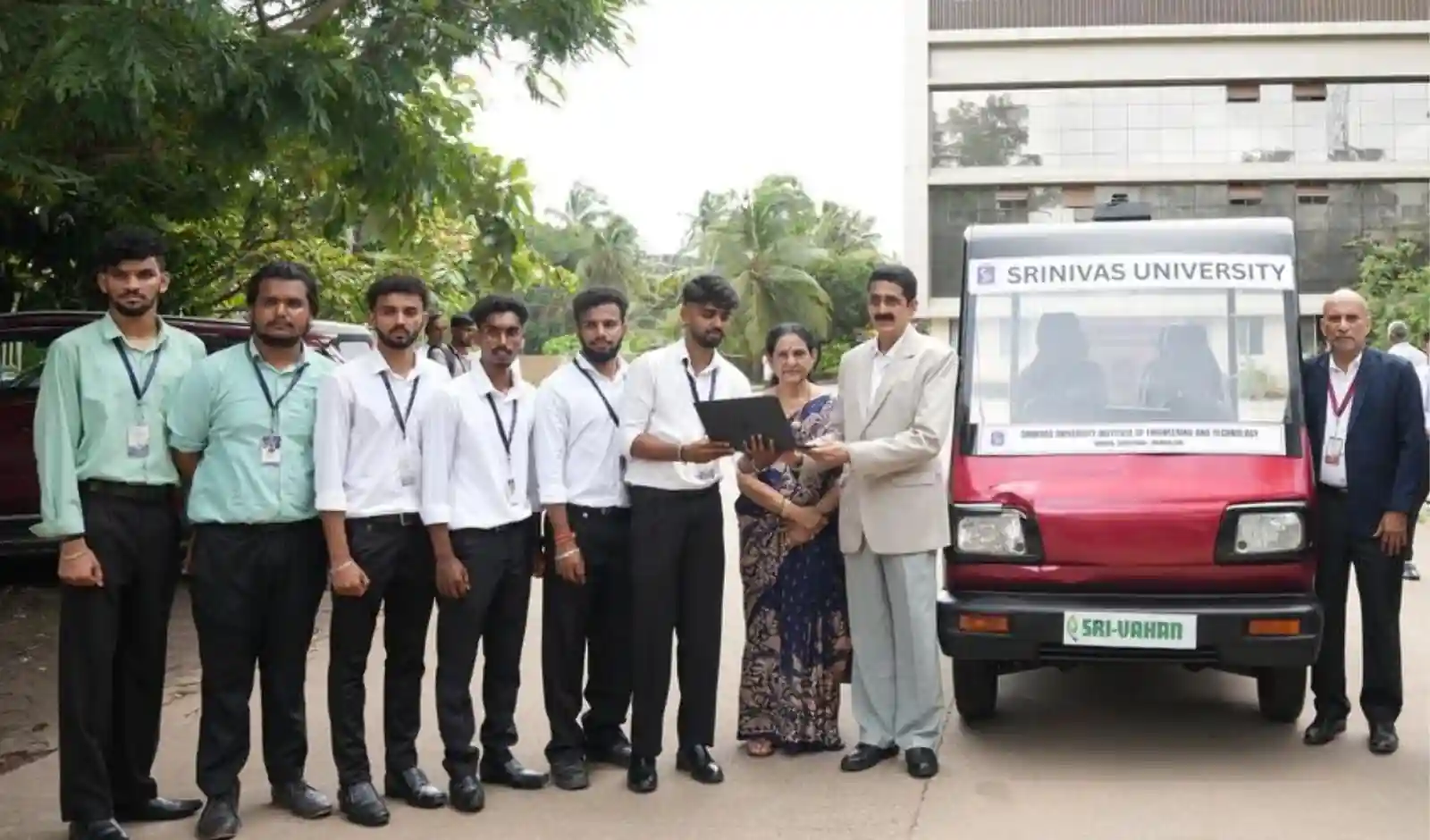
Students from the Institute of Engineering and Technology (IET), Srinivas University, Mukka, Karnataka, have developed an artificial intelligence (AI)-powered autonomous electric vehicle and an AI reception robot named SRINIBOT. The innovations were demonstrated at the university campus on Thursday.
According to the university, the retrofitted electric vehicle integrates LiDAR (Light Detection and Ranging), AI-based vision, GPS navigation, and an AI assistant. At present, the vehicle is capable of autonomous operation along a predefined route and includes a remote-control override system to enhance safety and operational flexibility. Research is currently underway to enable the vehicle to navigate autonomously in previously unmapped environments.
The six-seater autonomous EV has been designed to transport patients and is integrated with an ambulance rerouting application. It is powered by a 5 kW lithium-ion battery, providing around 1.5 hours of backup and a driving range of 20 km on a single charge. The vehicle can reach a maximum speed of 28 km/h in manual mode and 5 km/h in autonomous mode.
The project was guided by Professor Vishwas C. Shetty, while Research Associate Vishak Mendon served as the technical lead. The student team included Shreyas, Adwitiya, Ujjwal, Akshay, Manjunath, and Prakhyath.
AI Reception Robot 'SRINIBOT'
The students also showcased SRINIBOT, an AI-powered reception robot designed to enhance visitor engagement and modernise campus services. The robot is capable of welcoming visitors, answering queries, providing university information, and assisting students, parents, faculty members, and guests through natural voice interaction.
SRINIBOT features an 11.6-inch interactive touchscreen display, integrated camera with face detection and face recognition, natural voice conversation, and multilingual communication, making it suitable for assisting a diverse range of visitors.
The university said the project demonstrates its commitment to innovation, research, and next-generation automation by integrating artificial intelligence, computer vision, and human-robot interaction technologies.
The AI reception robot project was guided by Akhil K.P., while Research Associates Niketh Jadav, Joyal Jose, and Samarth Naganur coordinated and executed the development.


