


 223
/
3
Min Read
223
/
3
Min Read



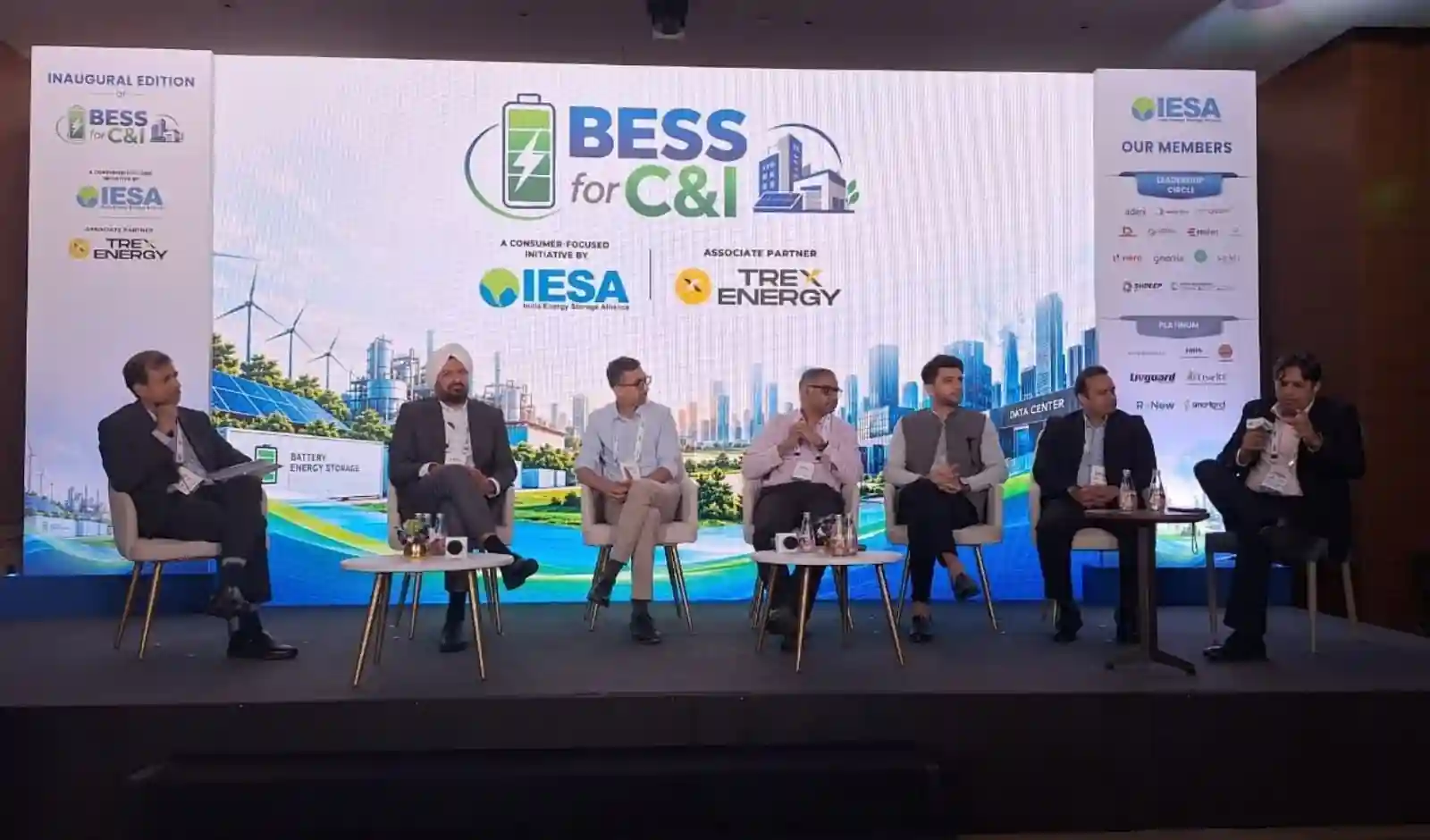
India commercial and industrial (C&I) battery energy storage capacity is growing rapidly, reaching around 650 MWh from 40 MWh previously. The capacity is projected to reach nearly 4 GWh by FY27. However, high upfront costs, evolving regulations, limited financing options and low user awareness continue to pose challenges to large-scale BESS adoption.
To address these challenges and accelerate battery storage adoption in the C&I sector, the India Energy Storage Alliance (IESA) has launched the ‘BESS for C&I’ initiative at the Jio World Convention Centre in Mumbai. The initiative aims to help 300 C&I consumers adopt energy storage solutions over the next three years.
Under ‘BESS for C&I’, monthly sessions will be held from October 2026, bringing together industry players, BESS developers and policymakers to discuss storage deployment, costs, business models and best practices.
Debmalya Sen, President, IESA, said the platform has been designed to address the specific challenges faced by C&I energy consumers. He noted that battery storage is becoming increasingly important for grid flexibility and business resilience, while collaboration, knowledge-sharing and innovation will be critical to accelerating adoption.
The initiative will operate as a dedicated and free workgroup for C&I consumers. As electricity demand rises, battery storage can help businesses manage energy costs and integrate renewable energy more effectively. IESA and industry leaders have called for policy measures and targeted incentives to accelerate C&I BESS deployment.
Bharat Chhittarka, Director, Trex Energy, said India needs to accelerate cell manufacturing and reduce dependence on imported raw materials to become a global battery manufacturing hub. According to him, imported raw materials currently account for around 60-70% of battery costs. He recommended clear state-level policies on Time-of-Day (TOD) tariffs, energy arbitrage and peak shaving.
Bimal Jindal, CEO, Energy Business, JBM Renewables, said India needs to strengthen its battery manufacturing and supply chain ecosystem through component manufacturing, lithium carbonate and cell production, as well as investment in R&D. He also suggested that the government consider reducing GST on BESS from 18% to 5% and increasing the mandated share of BESS deployment in relevant projects.
Sushmita R. Ajwani, Head of Business Development (C&I), Aditya Birla Renewables, said India needs to move beyond battery assembly and focus on domestic cell manufacturing supported by strong policy and financial measures. She added that clear regulatory guidelines and targeted incentives could accelerate BESS adoption.
Inder Bhambra, COO-BESS and Chief Business Officer, India region, Envision Energy India, said India needs to develop cell technologies and promote local assembly of DC containers to establish itself as a global BESS manufacturing hub. He also called for more supportive open-access regulations, including the removal of transmission-related charges and maximum demand charges for BESS charging.
Despite the growth in the sector, volatility in battery storage project costs remains a challenge. Utility-scale BESS capital expenditure has increased by around 15% in recent months. IESA said that appropriate policy support and stronger domestic supply chains can help drive the next phase of C&I battery storage growth.
Through its IESA Connect platform, IESA plans to take the initiative to cities and industrial clusters across India. The objective is to enable C&I consumers to actively participate in shaping policies, standards and safety frameworks, rather than simply remain buyers of BESS technology.


