


 251
/
4
Min Read
251
/
4
Min Read


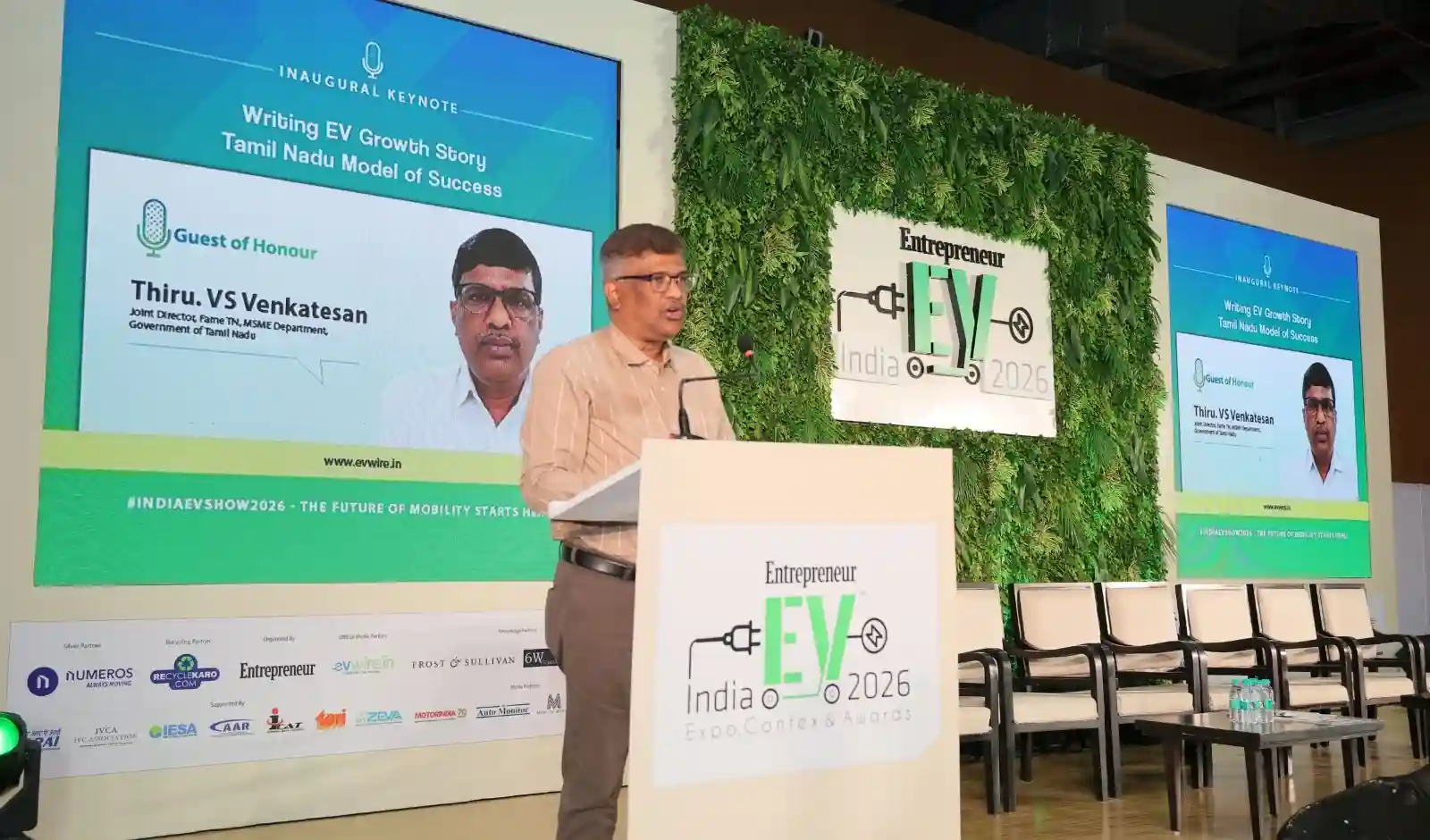
Tamil Nadu is emerging as one of India’s strongest manufacturing and investment hubs for electric mobility. Speaking at the Entrepreneur India EV Expo & Conference 2026, Thiru. V. S. Venkatesan, Joint Director, MSME Department & GM (I/C), FAME TN, outlined the state's roadmap for clean mobility, highlighting Tamil Nadu’s EV policy, the critical role of MSMEs, and its ambitious target of attracting ₹50,000 crore in investments.
He said that electric mobility is not merely about replacing conventional vehicles with electric ones. It represents a broader transformation encompassing manufacturing, innovation, energy systems, sustainability, and economic development. According to him, Tamil Nadu is fully prepared to lead this transition.
Beginning his address, he extended his greetings on International MSME Day and congratulated Entrepreneur India for bringing together policymakers, industry leaders, entrepreneurs, and researchers on a common platform to discuss the future of electric mobility.
A Strong MSME Ecosystem Is Tamil Nadu Biggest Strength
Venkatesan emphasized that Tamil Nadu’s industrial success is not driven by large industries alone. Its vibrant MSME ecosystem plays a vital role by manufacturing critical automotive components, developing innovative products, providing engineering services, generating employment, and strengthening local economies across the state.
He described MSMEs not merely as suppliers, but as innovators, solution providers, and indispensable partners in industrial growth.
Natural Advantage in EV Manufacturing
He noted that Tamil Nadu is already one of India's leading automobile and auto component manufacturing hubs. Regions such as Coimbatore have built strong capabilities in pumps, motors, foundries, and precision engineering, creating the technical expertise and skilled workforce required for manufacturing electric motors, powertrain components, and other critical EV systems.
According to him, Tamil Nadu’s EV success is the result of decades of industrial vision, policy continuity, infrastructure development, and manufacturing excellence—not a single policy or investment.
Progressive Policies Fueling Growth
Venkatesan said that the Government of Tamil Nadu has introduced several forward-looking initiatives, including the Tamil Nadu Electric Vehicle Policy 2023 and the State Research & Development Policy, to accelerate the state's EV ecosystem.
These policies provide dedicated incentives for EV manufacturers, component manufacturers, battery and cell manufacturers, charging infrastructure companies, and R&D activities. As a result, investments are expanding beyond vehicle manufacturing into electronics, software, advanced technologies, and innovation.
Up to 1.5 Crore Capital Subsidy for MSMEs
He highlighted that under the Tamil Nadu MSME Policy 2021, the manufacturing of EV components, charging infrastructure, and allied equipment has been identified as a priority sector. Eligible MSMEs can receive capital subsidies of up to ₹1.5 crore, enabling them to actively participate in the state's transition toward sustainable mobility.
50,000 Crore Investment and 1.5 Lakh Jobs
Tamil Nadu aims to attract ₹50,000 crore in EV investments and generate 1.5 lakh employment opportunities. The state's vision is to become India’s preferred electric vehicle manufacturing destination while emerging as a major production hub for South and Southeast Asia.
Opportunities Beyond Vehicle Manufacturing
Venkatesan stressed that the EV industry extends far beyond vehicle assembly. Significant opportunities exist in batteries, battery management systems, power electronics, control systems, and other advanced technologies. These sectors offer MSMEs the opportunity to diversify, integrate into domestic and global supply chains, and play a key role in India’s next industrial revolution.
Government Support Beyond Financial Incentives
He stated that the Tamil Nadu government is committed to supporting MSMEs not only through financial assistance but also by promoting entrepreneurship, facilitating technology adoption, developing modern industrial infrastructure, improving market access, encouraging quality certification, strengthening research and development, and enhancing access to finance.
The Next Step Towards Becoming a Global EV Hub
According to Venkatesan, the Tamil Nadu model demonstrates that sustainable industrial growth is achievable when visionary policies, industrial capability, world-class infrastructure, entrepreneurship, and a strong MSME ecosystem come together.
The next phase, he said, is to strengthen manufacturing clusters, integrate MSMEs into global value chains, and position Tamil Nadu as a trusted partner in the global clean mobility transition.
New Initiative for Electric Motor Testing
He also announced that the Tamil Nadu government has signed a Memorandum of Understanding (MoU) with SITAR, Coimbatore, to establish an electric motor and controller testing facility.
The project will receive 90% financial support from the Government of Tamil Nadu, amounting to ₹9 crore, while SITAR will contribute 1 crore toward the initiative.
Concluding his address, Venkatesan congratulated Entrepreneur India and all the knowledge partners for organizing the conference. He expressed confidence that the discussions would lead to new investments, stronger collaborations, technological innovation, and sustainable industrial growth, further accelerating both Tamil Nadu’s and India’s electric mobility journey.


