


 340
/
5
Min Read
340
/
5
Min Read


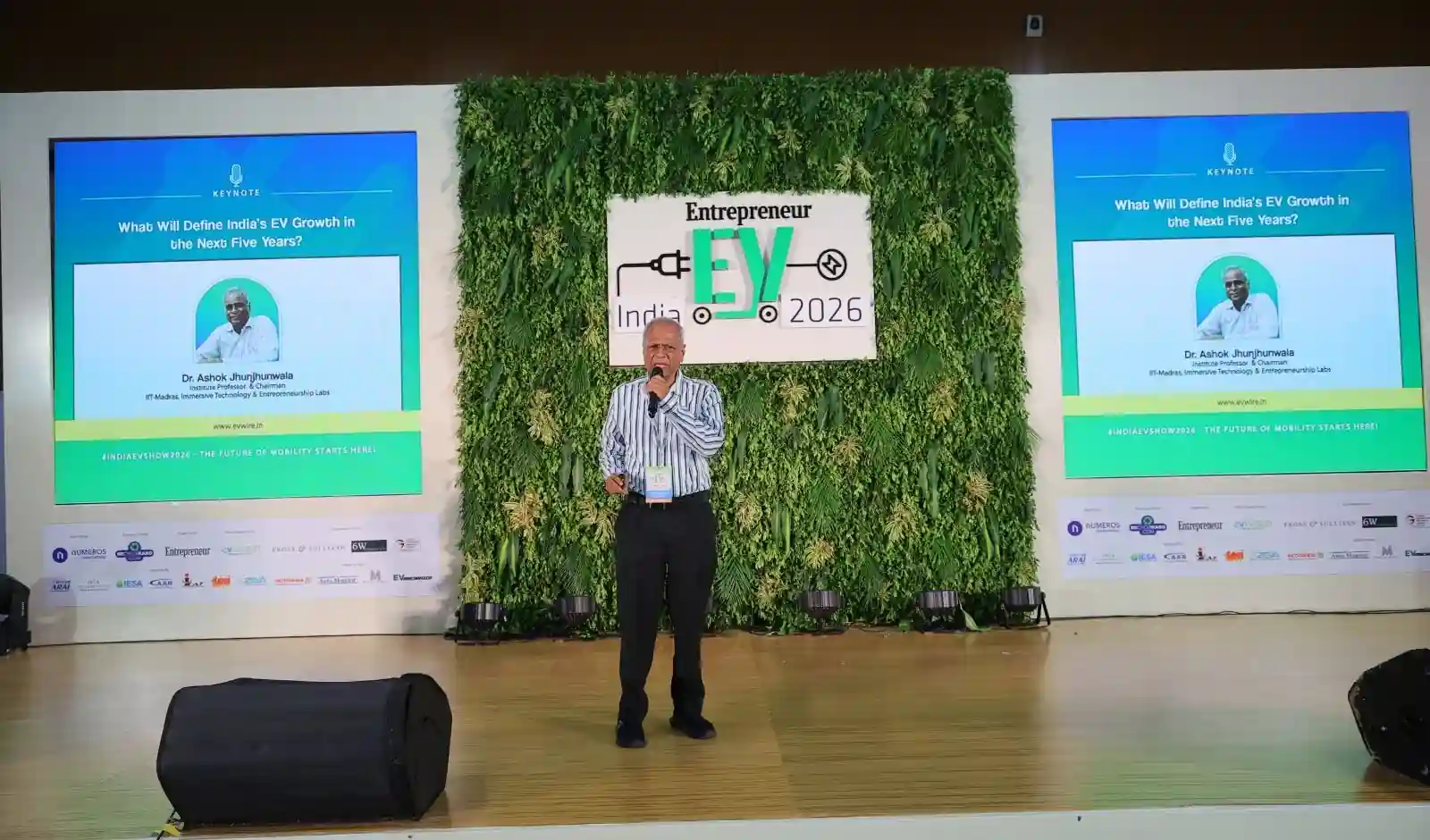
India electric vehicle (EV) revolution has reached a decisive stage, and the next five years will determine whether the country emerges as a global EV manufacturing leader or remains dependent on conventional mobility, said Dr. Ashok Jhunjhunwala, Institute Professor and Chairman, IIT Madras, and Chairman of Immersive Technology & Entrepreneurship Labs (ITEL), while delivering the keynote address on "What Will Define India's EV Growth in the Next Five Years" at the Entrepreneur India EV Conference.
Highlighting India heavy dependence on imported crude oil, Dr. Jhunjhunwala said the country can no longer afford to import nearly 85% of its oil requirements. Recent geopolitical tensions and rising oil prices have reinforced the urgency of shifting towards electric mobility. He noted that EV technology is now mature, economically viable across most vehicle segments, and backed by strong government intent. According to him, the biggest challenge is no longer technology or affordability but effective change management that makes EV adoption convenient for consumers.
Addressing environmental concerns, he emphasized that deteriorating air quality across Indian cities has made the transition to electric mobility a necessity rather than a choice. Citing Delhi's Air Quality Index crossing 460 and estimates that nearly 1.7 million deaths occur annually in India due to air pollution, he said vehicle emissions remain one of the primary contributors. Since electric vehicles produce zero tailpipe emissions, widespread electrification can play a major role in improving urban air quality.
Dr. Jhunjhunwala also explained that electric vehicles are significantly more energy-efficient than internal combustion engine (ICE) vehicles. While petrol vehicles utilize only about 25% of the energy they consume, electric vehicles achieve efficiencies of nearly 80–90%, aided further by regenerative braking. This translates into substantially lower energy consumption and reduced carbon emissions over time.
Beyond sustainability, he described electrification as a strategic industrial opportunity. As global markets rapidly transition towards EVs, India has the potential to become a major manufacturing and export hub. However, he cautioned that continuing to rely on conventional ICE technologies could result in India losing competitiveness in both domestic and international markets.
One of the biggest barriers to faster EV adoption, according to Dr. Jhunjhunwala, is inadequate access to residential charging. He revealed that a committee constituted by the Supreme Court and the Commission for Air Quality Management (CAQM) is working on a proposed "Right to Charge" Bill, which would legally empower EV owners to install charging points in apartments and housing societies. The proposed legislation would prevent Resident Welfare Associations, landlords and building managers from denying charging installations while ensuring electricity utilities facilitate connections with minimal procedural hurdles.
He noted that low-power residential chargers ranging from 3 kW to 11 kW can meet nearly 95% of daily charging needs and do not place significant additional load on the electricity grid. Simplifying approvals for such chargers, he said, will be critical for mass EV adoption.
Discussing localization, Dr. Jhunjhunwala pointed out that India has made significant progress in battery pack manufacturing, while domestic battery cell production is also gaining momentum with multiple gigafactory projects underway. Several companies, including new manufacturers and startups, are investing in advanced battery technologies, recycling infrastructure and indigenous material development. He stressed that strengthening research and development for next-generation battery chemistry remains essential for long-term self-reliance.
He also highlighted India's progress in electric motors, power electronics and charging equipment, noting that many critical components are now being designed and manufactured domestically. However, he urged policymakers to encourage original Indian design rather than simple assembly of imported products. Greater investment in software, vehicle intelligence and user experience, he added, will be equally important for creating globally competitive EV products.
On market readiness, Dr. Jhunjhunwala observed that electric two-wheelers have already reached purchase price parity with petrol models, while electric passenger cars are rapidly approaching the same milestone as battery prices continue to decline. He expects further reductions in EV prices over the coming months, making electric mobility increasingly attractive across vehicle categories. He also advocated continued tax incentives for EVs, discouraging conventional petrol vehicles and supporting retrofit solutions that allow existing vehicles to be converted into electric models.
Looking beyond electrification, Dr. Jhunjhunwala said India's urban mobility challenges cannot be solved by EVs alone. He unveiled IIT Madras' work on an innovative autonomous urban transportation system designed to enable citizens to travel up to 15 kilometres within approximately 20 minutes using compact elevated mobility corridors. Prototype testing is already underway, with pilot deployments planned in the near future. He also outlined a vision for an advanced freight transport network capable of moving goods across India within 24 hours.
Concluding his keynote, Dr. Jhunjhunwala expressed confidence that India's EV transition will accelerate dramatically over the next five years, with nearly 70–80% of new vehicle sales expected to shift towards electric mobility. However, he emphasized that long-term success will depend on integrating EV adoption with renewable energy generation, battery recycling, indigenous innovation and future-ready transportation systems. He urged India not merely to adopt global technologies but to develop homegrown mobility solutions capable of leading the world.


