


 290
/
5
Min Read
290
/
5
Min Read


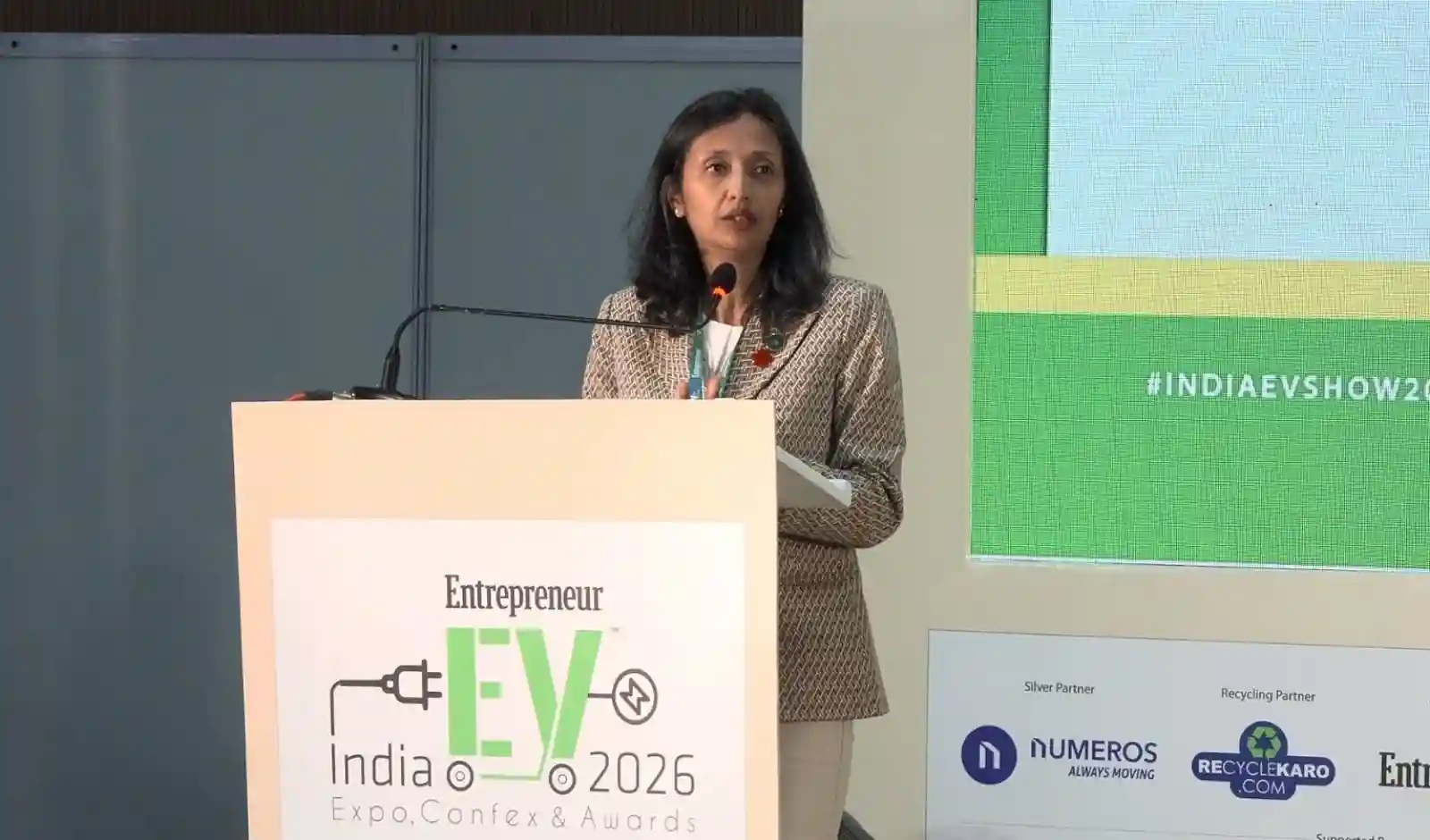
India EV industry is moving beyond the adoption phase and steadily heading toward global leadership. Innovation, local manufacturing, battery technology, and collaboration are emerging as the biggest drivers of this transformation.
Speaking at the Entrepreneur India EV Expo & Conference 2026,Ashita Marya, CEO & Consulting Editor of Entrepreneur India Media, said that India’s electric vehicle (EV) industry has moved beyond the experimental stage and is rapidly evolving into a strong and mature sector. She emphasized that the coming decade will not merely be about increasing the number of EVs on Indian roads, but about positioning India as a global leader in electric mobility.
In her inaugural address, she noted that the nature of discussions around electric mobility has changed dramatically over the past few years. Earlier, the key question was whether India was ready to adopt EVs; today, the focus has shifted to how India can achieve global leadership in electric mobility. This change, she said, is a clear indication that EVs are no longer a technology of the future—they are a reality of the present.
She highlighted that India registered more than 2.4 million electric vehicles in the last financial year, with EVs accounting for approximately 8.5% of new vehicle registrations. According to her, these numbers reflect not just sales growth, but also rising consumer trust, industry confidence, and the impact of long-term government policies.
India EV Journey Is Different from the Rest of the World
Ashita Marya said that India EV story has unfolded differently from that of many other countries. While electric mobility in most global markets began with premium and luxury cars, India’s transition has been led by two-wheelers, three-wheelers, e-rickshaws, last-mile delivery vehicles, and fleet operations.
She cited Delhi-NCR as an example, where commuters increasingly use e-rickshaws and electric vehicles for first- and last-mile connectivity from metro stations. She also noted that a large share of e-commerce and quick-commerce deliveries is now being carried out using electric fleets. Many municipal sanitation vehicles have also become electric, making India’s model potentially relevant for other emerging economies.
More Than Vehicles: A Complete Ecosystem
According to her, electric mobility is no longer just an automobile industry. It has evolved into a comprehensive ecosystem that includes battery technology, software, artificial intelligence, power electronics, energy management, charging infrastructure, financial services, and public policy.
She stressed that no single company can build such a large ecosystem alone. Strong collaboration among industry players, startups, governments, investors, educational institutions, and technology experts is essential.
The Next Goal: Building Domestic Capabilities
Ashita Marya pointed out that India still relies heavily on imports for battery cells, semiconductors, and several critical raw materials. Therefore, the next phase of the EV industry will not be just about selling more vehicles, but about strengthening domestic manufacturing capabilities.
She said that battery manufacturing, advanced chemistry, battery recycling, resilient supply chains, and indigenous technology development will determine India’s long-term competitiveness. In her view, future leadership will belong to countries that control both technology and manufacturing capacity.
Why Tamil Nadu Is Emerging as an EV Hub
She described Tamil Nadu as India’s automotive capital, with world-class manufacturing, skilled engineering talent, a strong supplier network, export infrastructure, and industrial expertise. This, she said, is why Entrepreneur India chose Chennai as the venue for the EV Expo & Conference.
As global companies rethink supply chains and investment destinations, Tamil Nadu is well positioned to become a major center for electric mobility manufacturing and innovation.
Batteries and Charging Will Drive the Biggest Changes
Marya said that the future of the EV industry will be shaped by battery technology, fast charging, energy storage, and recycling. Batteries determine vehicle cost, range, charging speed, safety, and overall performance, making research and investment in this area critically important.
She also emphasized that expanding charging infrastructure is the most important prerequisite for EV adoption. Without a robust charging network, both consumers and fleet operators will face challenges. Many companies are already creating new entrepreneurial opportunities through charging-station franchise models.
AI and Software Will Define the Future
In the coming years, vehicles will become “computers on wheels”, she said. Artificial intelligence, software, connectivity, battery management, predictive maintenance, and fleet management will become the most important components of the mobility industry.
India, she added, possesses world-class software talent, and if leveraged effectively, the country can emerge as a global leader in EV technology as well.
Major Opportunities for Investors and Startups
Investment in the electric mobility ecosystem is steadily increasing. She identified battery manufacturing, charging infrastructure, exports, fleet electrification, and AI-driven solutions as the five major opportunity areas likely to witness significant growth in the coming years.
She urged investors to support emerging startups and innovations so that India can strengthen its position in global competition.
Collaboration Will Shape the Future
Concluding her address, Ashita Marya said that collaboration has always been India’s greatest strength, and the future of the EV industry will also depend on partnerships. Strong cooperation among startups, industry, government, academia, and investors will be crucial for India to achieve global EV leadership.
She said the Entrepreneur India EV Expo & Conference is not just an exhibition, but a platform designed to connect stakeholders, create investment opportunities, foster partnerships, and accelerate India’s electric mobility journey.
She encouraged all participants to engage meaningfully with exhibitors, explore new business opportunities, and lay the foundation for future collaborations. Expressing confidence about the future, she said that by 2030, India’s goal should not be merely to become a nation that adopts EVs, but to establish itself as a global leader in electric mobility technology, manufacturing, and innovation.


